
 Instrument type: LIDAR
Measured species: atmospheric temperature, wind, and iron density
Mission participation: SouthTRAC (2019), WAVEGUIDE (2026)
Instrument PI: DLR-PA
ALIMA is a powerful iron-resonance and Rayleigh lidar system for airborne measurements in the middle atmosphere, including the stratosphere, mesosphere and lower thermosphere. The instrument probes the iron line at 372 nanometres.
Link to instrument webpage: https://www.dlr.de/en/pa/research-transfer/research-infrastructure/instruments/alima
References: (TBA)
 Instrument type: integrated path differential absorption (IPDA) lidar
Measured species: column concentrations of CO2 and CH4
Mission participation: CoMet (2018), CoMet 2.0 Arctic (2022), CoMet 3.0 Tropics (2026)
Instrument PI: DLR-PA
This unique lidar system is capable of measuring the column concentration of the two most important anthropogenically influenced greenhouse gases, carbon dioxide (CO2) and methane (CH4), below the aircraft at the same time. CHARM-F was developed as a scientific instrument to help understanding the distribution of those greenhouse gases on local and regional scales and their cycles, but also as an airborne demonstrator for the German-French methane mission MERLIN.
Link to instrument webpage: https://www.dlr.de/en/pa/research-transfer/research-infrastructure/instruments/charm-f
References:
Amediek A. et al., (2017): CHARM-F – a new airborne integrated-path differential-absorption lidar for carbon dioxide and methane observations: measurement performance and quantification of strong point source emissions, Appl. Opt. 56, 5182-519, doi: 10.1364/AO.56.005182.
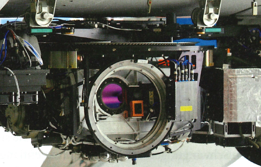 Instrument type: limb-viewing imaging Fourier transform spectrometer (FTS)
Measured species: temperature, trace-gas concentrations, as well as information on aerosol and cloud
Mission participation: TACTS/ESMVal (2012), POLSTRACC/GW-LCYCLE/SALSA (2015/16), WISE (2017), SouthTRAC (2019)
Instrument PI: FZ Jülich / KIT
With the Gimbaled Limb Observer for Radiance Imager of the Atmosphere (GLORIA) instrument the first and only limb-viewing imaging Fourier transform spectrometer (FTS) operated on board of high altitude research aircraft (HALO) to derive 2- and 3-D distribution of atmospheric parameters.
Link to instrument webpage: https://www.fz-juelich.de/en/ite/science/research_areas/earth-environment/gloria-fts
References:
Riese, M. et al. (2014): Gimballed Limb Observer for Radiance Imaging of the Atmosphere (GLORIA) scientific objectives, Atmos. Meas. Tech., 7, 1915–1928, https://doi.org/10.5194/amt-7-1915-2014
Friedl-Vallon, F. et al., (2014): Instrument concept of the imaging Fourier transform spectrometer GLORIA, Atmos. Meas. Tech., 7, 3565–3577, https://doi.org/10.5194/amt-7-3565-2014.
 Instrument type: multi-wavelength H2O-DIAL (differential absorption lidar)
Measured species: water vapor profiles from the lower stratosphere to the planetary boundary layer
Mission participation: NAWDIC (2026), ASCCI (2025), PERCUSION (2024), HALO-(AC)3 (2021), CIRRUS-HL (2021), EUREC4A (2020), WISE (2017), NAWDEX (2016), NARVAL 2 (2016), POLSTRACC/GW-LCYCLE/SALSA (2015/16), ML-CIRRUS (2014)
Instrument PI: DLR-PA
This high-performance airborne water vapor differential absorption lidar uses a four-wavelength/three-absorption line measurement scheme in the 935 nm H2O absorption band to cover the whole troposphere and lower stratosphere simultaneously. Additional high spectral resolution aerosol and depolarization channels allow precise aerosol characterization.
Link to instrument webpage: https://www.dlr.de/en/pa/research-transfer/research-infrastructure/instruments/wales
References:
Wirth, M., Fix, A., Mahnke, P. et al. (2009): The airborne multi-wavelength water vapor differential absorption lidar WALES: system design and performance. Appl. Phys. B 96, 201–213, doi: 10.1007/s00340-009-3365-7.
 Instrument type: single particle laser ablation instrument
Measured species: composition of aerosol particles and cloud residuals
Mission participation: CAFE-AFRICA (2018), CIRRUS-HL (2021), HALO-South (2025)
Instrument PI: MPI-C (Mainz)
The ALABAMA is a single particle laser ablation instrument that was developed especially for aircraft operation onboard HALO.
Link to instrument webpage: https://www.mpic.de/3578579/ALABAMA
References: Clemen, H.-C. et al., (2020): Optimizing the detection, ablation, and ion extraction efficiency of a single-particle laser ablation mass spectrometer for application in environments with low aerosol particle concentrations, Atmos. Meas. Tech., 13, 5923–5953, https://doi.org/10.5194/amt-13-5923-2020.
Brands, M. et al., (2020): Characterization of a Newly Developed Aircraft-Based Laser Ablation Aerosol Mass Spectrometer (ALABAMA) and First Field Deployment in Urban Pollution Plumes over Paris During MEGAPOLI 2009, Aerosol Sci. Technol., 45, 46-64, doi: 10.1080/02786826.2010.517813.
 Instrument type: Aerosol Mass Spectrometer
Measured species: size and chemical mass loading information for non-refractory sub-micron aerosol particles
Mission participation: ACHRIDICON-CHUVA (2014), EMeRGe-EU (2017), EMeRGe-Asia (2018), CAFE-Africa (2018), BLUESKY (2020), CAFE-Brazil (2022/23), CAFE-Pacific (2024), HALO-South (2025)
Instrument PI: MPI-C (mainz)
The instrument has been designed to provide real-time quantitative information on size-resolved mass loadings for volatile and semi-volatile molecular components present in/on ambient aerosol particles.
Link to instrument webpage: https://www.mpic.de/3578524/c-tof-ams1
References:
Basic instrument description:
Drewnick, Fet al., (2005): A new Time-of-Flight Aerosol Mass Spectrometer (TOF-AMS) : Instrument Description and First Field Deployment, Aerosol Science & Technology 39, 637-658, doi:10.1080/02786820500182040.
Aircraft application:
Schmale, J. et al., (2010): Aerosol layers from the 2008 eruptions of Mt. Okmok and Mt. Kasatochi: In-situ UT/LS measurements of sulfate and organics over Europe, J. Geophys. Res., 115, D00L07, doi:10.1029/2009JD013628.
Schmale, J. et al., (2011): Source identification and airborne chemical characterisation of aerosol pollution from long-range transport over Greenland during POLARCAT summer campaign 2008, Atmos. Chem. Phys., 11, 10097-10123, doi:10.5194/acp-11-10097-2011.
Schulz, C. et al., (2018): Aircraft-based observations of isoprene-epoxydiol-derived secondary organic aerosol (IEPOX-SOA) in the tropical upper troposphere over the Amazon region, Atmos. Chem. Phys., 18, 14979-15001, doi:10.5194/acp-18-14979-2018.
Instrument type: Off-Axis-Integrated-Cavity-Output-Spectroscopy (ICOS)
Measured species: OCS, CO2, CO, CH4and H2O (tropospheric)
Mission participation:
Instrument PI: FZ Jülich
This spectrometer carries out high resolution carbonyl sulfide (OCS) measurements during aircraft campaigns to improve our understanding of the contribution of OCS to the stratospheric aerosol layer. It uses the Off-Axis-Integrated-Cavity-Output-Spectroscopy (ICOS) measurement technique to determine OCS, CO2, CO, CH4 and tropospheric H2O.
Link to instrument webpage: https://www.fz-juelich.de/en/ice/ice-4/research/synergetic-use-of-instruments-and-models/halo
References: Kloss, C. et al., 2021, Airborne Mid-Infrared Cavity enhanced Absorption spectrometer (AMICA), Atmos. Meas. Tech., 14, 5271–5297, doi:10.5194/amt-14-5271-2021
Instrument type: Lyman-α hygrometer
Measured species: total/gas-phase H2O
Mission participation:
Instrument PI: FZ Jülich
The Lyman-α hygrometer FISH (Fast In-situ Stratospheric Hygrometer) is one of the most advanced and sensitive in-situ instruments world-wide for mea- suring water vapor in the UTLS. This climate-sensitive region has the lowest water vapor concentrations, making it a particular challenge for measuring in- struments. For almost three decades the instrument was flown on many different research aircraft and places around the world and measured water vapor and the ice water content of cirrus clouds.
Link to instrument webpage: https://www.fz-juelich.de/en/ice/ice-4/research/synergetic-use-of-instruments-and-models/halo
References: Meyer et al., 2015, Two decades of water vapor measurements with the FISH fluorescence hygrometer: a review, Atmos. Chem. Phys., 15, 8521–8538, doi:10.5194/acp-15-8521-2015.
Zöger et al., 1999, Fast in situ stratospheric hygrometers: A new family of balloon-borne and airborne Lyman α photofragment fluorescence hygrometers. J. Geophys. Res., doi: 10.1029/1998JD100025.
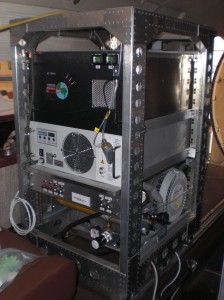 Instrument type: Quantum Cascade Laser based spectrometer
Measured species: N2O, CO
Mission participation: WISE (2017), PHILEAS (2023), ASCCI (2025), NAWDIC (2026)
Instrument PI: JGU Mainz
UMAQS is based on the “Aerodyne Research Inc.“ Quantum Cascade Laser Mini Monitor which uses an astigmatic multi path Herriot cell with an optical pathlength of 76m. This instrument applies the direct absorption spectroscopy.
Link to instrument webpage: https://www.blogs.uni-mainz.de/fb08-ipa-en/messinstrumenteaghoor/
References: Müller, S. et al., 2015, In situ detection of stratosphere-troposphere exchange of cirrus particles in the midlatitudes, Geophys. Res. Lett. 42: 949–955. doi: 10.1002/2014GL062556.
Kunkel, D. et al., 2019, Evidence of small-scale quasi-isentropic mixing in ridges of extratropical baroclinic waves, Atmos. Chem. Phys., 19, 12607–12630, doi:10.5194/acp-19-12607-2019.