
PHILEAS
Probing High Latitude Export of air from the Asian Summer Monsoon
Mission status: Completed
Skip to: >>Project description | >>Partners | >>Instrumentation | >>Mission flights | >>Media & Press
Persons in Charge
Mission-PI
- Peter Hoor, Univ. Mainz
- Martin Riese, FZ Jülich
Contact point at DLR-FX for this mission
Andreas Minikin (HALO Project Management): +49 (0)8153 28-2538, andreas [dot] minikin [at] dlr [dot] de
HALO Deployment Base
HALO will be operated from two bases during this campaign:
Time Period
June – October 2023
Mission phases
- 05 Jun 23 – 04 Aug 23 || Preparation, Payload integration, EMI testing
- 05 Aug 23 – 20 Aug 23 || Mission execution: Oberpfaffenhofen; Phase I
- 23 Aug 23 – 21 Sep 23 || Mission execution: Anchorage (USA); Phase II
- 25 Sep 23 – 30 Sep 23 || Mission execution: Oberpfaffenhofen; Phase III
- 04 Oct 23 – 13 Oct 23 || Dismounting of Payload
Project description
Mission overview paper
Citation:
Riese, M., Hoor, P., and Coauthors, 2025: Long-range transport of polluted Asian summer monsoon air to high latitudes during the PHILEAS campaign in the boreal summer 2023. Bull. Amer. Meteor. Soc., , BAMS-D-24-0232.1, https://doi.org/10.1175/BAMS-D-24-0232.1, in press.
Scientific rationale:
The composition of the upper troposphere and lower stratosphere (UTLS) with radiatively active trace gas species is a key factor for Earth‘s climate, as relatively small
changes in this composition cause large changes in surface temperatures. A particularly large radiative effect results for water vapour and aerosol (e.g., Solomon et al., 2010). Despite the urgency to correctly predict water vapour in numerical weather forecast and climate models, the distribution of water vapour across the tropopause and in the lower stratosphere (LS) is not well quantified and poorly constrained in numerical models.
In summer and early autumn East and South-east Asia is an important region for water vapour and other trace species to enter the lower stratosphere. Several dynamical features cause transport of trace species with near surface sources first into the UT and potentially further into the LS. This leads initially to an alteration of the composition of the UTLS over this region. A good example is the Asian Tropopause Aerosol Layer (ATAL) which is thought to be a direct consequence of the upward motions within the Asian summer monsoon (ASM). It has recently been shown that the ATAL consists to a large part of ammonium nitrate particles and affects the regional climate.
The ASM circulation during Northern summer is also thought to be the major pathway for tropospheric air masses, rich in water vapour, aerosol precursors and pollutants, into the UTLS. During summer (July-August), the large-scalenanticyclonic circulation in the UTLS traps lifted polluted air over Asia. Subsequently, when this circulation becomes weaker and more unstable, external forces disturb the temporally isolated system. Ultimately, frequent but irregular events of eddy shedding occur which lead to transport of polluted air from within the anti-cyclone into the extratropical LS. Observations and model simulations suggest a strong moistening effect of the eddy shedding transport on the Northern hemisphere UTLS, but with the strength of this effect being highly uncertain due to a lack of available observational data with sufficient precision and coverage. Very recent observations show evidence for a strong contribution of ammonium nitrate transport by the ASM to the UTLS aerosol budget and the ATAL, likely relevant for cirrus cloud formation.
Furthermore, the UTLS trace gas composition over the Eastern Pacific is affected by additional pathways in late summer and autumn: i) quasi-horizontal transport across the subtropical jet, exchanging air between the tropical UT and the extratropical LS, ii) vertical convective transport by tropical typhoons, which eventually move towards the extratropics, and iii) transport within extratropical weather systems, in particular, within warm conveyor belts and convection. All these features alter the composition of the UTLS over the eastern Pacific, thereby setting the initial chemical conditions before the air masses are transported further to middle and high latitudes and mix with LS background air. Initially, the respective chemical anomalies are relatively isolated within the shed eddy. Processes related to Rossby and gravity wave dynamics as well as diabatic forcings due to clouds in the UT and/or radiation lead to a mixing of these isolated anomalies into the background stratosphere. However, the time scales and the relative contribution of the underlying processes and their impact at different altitudes in the extratropical UTLS is largely unknown. Thus the temporal variability of the composition and in particular the gradients of radiatively active trace species are largely uncertain. This, in turn, is of importance for climate.
To investigate the relative importance of these processes contributing to the chemical composition of the UTLS we plan to characterize the evolution of the chemical composition of filaments during the full life cycle of eddy shedding process from the monsoon anticyclone and their effect particularly on the gradients of radiatively active species in the UTLS.
Key research questions:
1. What are the chemical composition and microphysical properties of the gas and particulate phase of large-scale eddies which are shed from the monsoon anticyclone?
2. What are the main transport pathways (advection and mixing) and time scales of polluted and moist air from the monsoon into the extratropical UTLS?
3. How do these shed eddies impact on the extratropical UTLS, and in particular on the water vapour and aerosol budget?
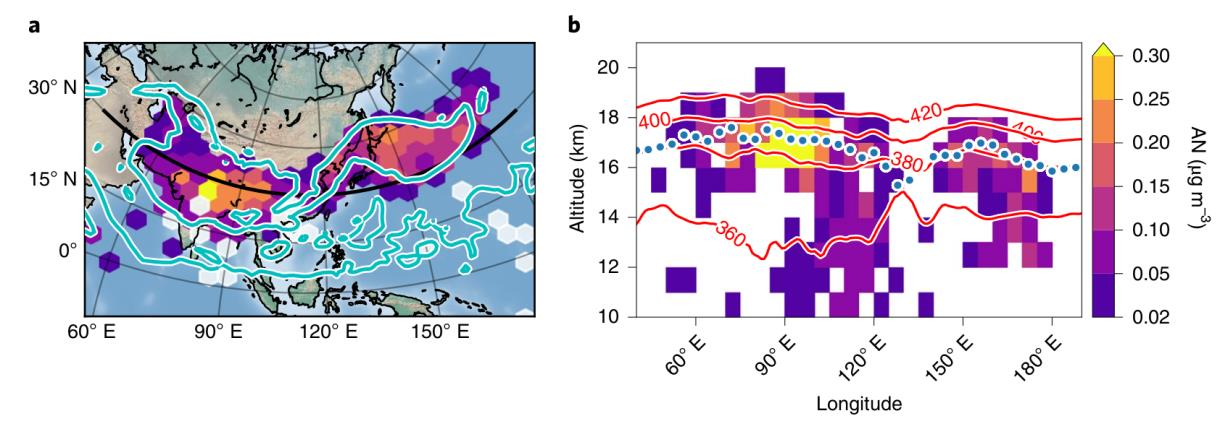
Fig. 1: Eddy shedding event from the Asian monsoon anticyclone in August 1997 as viewed by CRISTA ammonium nitrate measurements (colour shading).
The cyan line in (a) shows the 4.1 PVU contour, the black line the location of the cross-section in (b).
Within the proposed project the further fate of the shed eddy will be investigated.
Partners
- Forschungszentrum Jülich (FZ Jülich)
- Johannes Gutenberg University Mainz (JGU)
- Karlsruhe Institute of Technology (KIT)
- German Aerospace Center (DLR)
- Leibniz Institute for Tropospheric Research, Leipzig (TROPOS)
- Max Planck Institute for Chemistry, Mainz (MPIC)
- Goethe University Frankfurt
- University of Wuppertal
Scientific instruments and payload configuration
List of scientific instruments for the mission:
-
GLORIA
Gimballed Limb Observer for Radiance Imaging of the Atmosphere | F. Friedl-Vallon (KIT) & P. Preuße (FZJ)
-
FISH
Fast In-situ Stratospheric Hygrometer | M. Krämer (FZJ)
-
FAIRO
Fast ozone measurement | A. Zahn (KIT)
-
IPA-NOy (AENEAS)
NOY measurement | H. Ziereis (DLR-PA)
-
AIMS
Atmospheric Chemical Ionization Mass Spectrometer | C. Voigt & T. Jurkat (DLR-PA )
-
UMAQS
Quantum cascade laser absorption spectroscopy | Peter Hoor, & H. Bozem (JGU Mainz)
-
HAGAR
High Altitude Gas AnalyzeR | M. Volk (Univ. Wuppertal)
-
GhOST
Gaschromatograph for Observation of Stratospheric Tracers | A. Engel & H. Bönisch (Univ. Frankfurt)
-
AMICA
Airborne Mid-Infrared Cavity enhanced Absorption spectrometer | M. von Hobe (FZ Jülich)
-
ERICA
ERc Instrument for the Chemical composition of Aerosols, aerosol particle mass spectrometer | J. Schneider (MPI-C) & F. Köllner (Univ. Mainz)
-
BCPD
Backscatter Cloud Probe with Depolarization detection | T. Jurkat (DLR-PA)
-
FASD
Aerosol number and size distribution, including nucleation mode particles 1.5 nm to 5 μm | M. Pöhlker (TROPOS)
-
BAHAMAS
HALO Basic Data Acquisition System | A. Giez (DLR-FX)
HALO flights for this mission
Flights are listed by
Aircraft registration | Date | Take-off / Landing (UT) | Total flight time (h) | From / To | Mission #
- D-ADLR | 2023-07-25 | 09:16 -12:38 | 3.92 | EDMO-EDMO | F01 „Alzenau“
- D-ADLR | 2023-08-06 | 07:04 – 15:47 | 8.87 | EDMO-EDMO | F02 „Bitburg“
- D-ADLR | 2023-08-09 | 09:10 – 10:31 | 1.48 | EDMO-EDMO | F03 „Bahamas“
- D-ADLR | 2023-08-10 | 07:35 – 15:09 | 7.73 | EDMO-EDMO | F04 „Cologne“
- D-ADLR | 2023-08-12 | 07:05 – 15:02 | 8.17 | EDMO-EDMO | F05 „Dortmund“
- D-ADLR | 2023-08-16 | 06:56 – 14:39 | 7.92 | EDMO-EDMO | F06 „Elberfeld“
- D-ADLR | 2023-08-21 | 08:40 – 12:23 | 3.85 | EDMO-BIKF | F07 „Frankfurt“
- D-ADLR | 2023-08-21 | 13:59 – 20:42 | 7.07 | BIKF-PANC | F07 „Frankfurt“
- D-ADLR | 2023-08-26 | 17:57 – 02:14 | 8.60 | PANC-PANC | F08 „Gilching“
- D-ADLR | 2023-08-28 | 18:18 – 02:55 | 8.95 | PANC-PANC | F09 „Hambach“
- D-ADLR | 2023-08-31 | 16:07 – 00:04 | 8.27 | PANC-PADK | F10 „Jülich“
- D-ADLR | 2023-09-01 | 01:11 – 03:46 | 2.90 | PADK-PANC | F10 „Jülich“
- D-ADLR | 2023-09-01 | 21:17 – 03:52 | 7.20 | PANC-PANC | F11 „Karlsruhe“
- D-ADLR | 2023-09-07 | 18:04 – 02:12 | 8.43 | PANC-PANC | F12 „Kassel“
- D-ADLR | 2023-09-09 | 18:02 – 03:05 | 9.32 | PANC-PANC | F13 „Limburg“
- D-ADLR | 2023-09-10 | 19:58 – 05:03 | 9.28 | PANC-PANC | F14 „Mainz“
- D-ADLR | 2023-09-13 | 18:02 – 02:55 | 9.15 | PANC-PANC | F15 „Nordenstadt“
- D-ADLR | 2023-09-15 | 21:58 – 07:12 | 9.48 | PANC-PANC | F16 „Offenbach“
- D-ADLR | 2023-09-16 | 22:06 – 06:23 | 8.63 | PANC-PANC | F17 „Paderborn“
- D-ADLR | 2023-09-19 | 17:54 – 02:41 | 9.03 | PANC-PANC | F18 „Remscheid“
- D-ADLR | 2023-09-22 | 21:55 – 07:17 | 9.68 | PANC-EDMO | F19 „Solingen“
- D-ADLR | 2023-09-27 | 07:38 – 16:07 | 8.68 | EDMO-EDMO | F20 „Wuppertal“
More information
Mission overview paper
Citation:
Riese, M., Hoor, P., and Coauthors, 2025: Long-range transport of polluted Asian summer monsoon air to high latitudes during the PHILEAS campaign in the boreal summer 2023. Bull. Amer. Meteor. Soc., , BAMS-D-24-0232.1, https://doi.org/10.1175/BAMS-D-24-0232.1, in press.
Press releases, media etc.
Initial Press release
HALO research aircraft to analyze the transport of greenhouses gases and aerosols over the Pacific
Read more.. (English) | Weiterlesen.. (Deutsch)
>> Find all HALO updates, Media releases, and meeting announcements.