
HALO priority topics
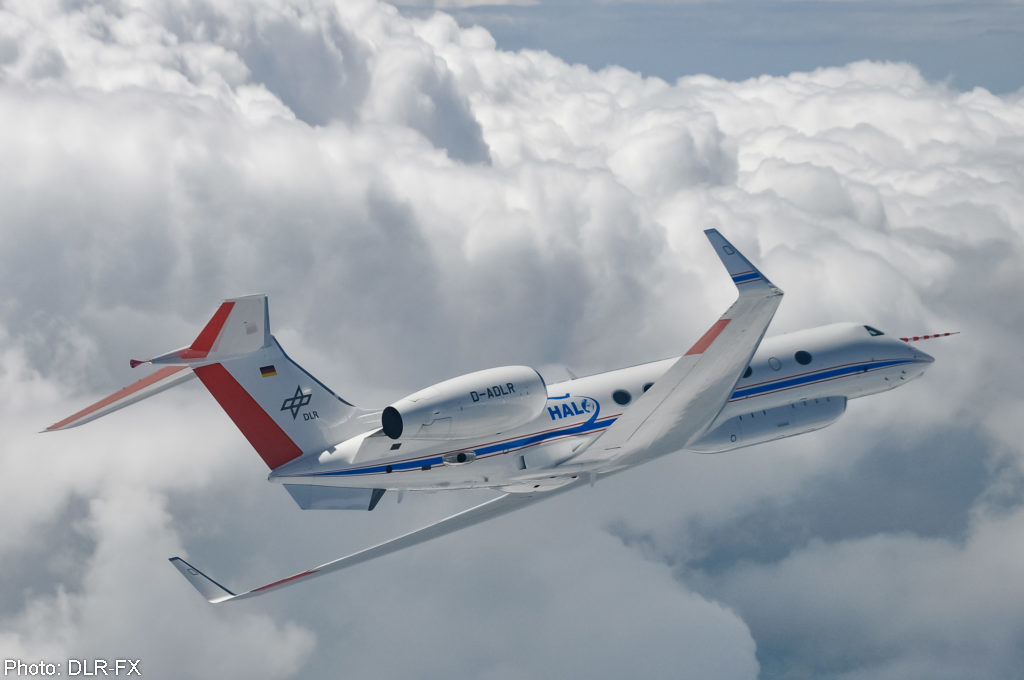
(B) Formation, Evolution, and Radiative Effects of Clouds and Precipitation
Clouds play a fundamental role in weather and climate processes as decisive factors determining the solar and terrestrial radiation energy fluxes and the formation of precipitation (IPCC, 2013). The latter aspect, namely the role of clouds in the atmospheric water cycle and the water cycle, are subject of current research, which could strongly benefit from the new capabilities offered by HALO.
Formation and Evolution of Clouds and Precipitation
Only a small fraction of the water in the atmosphere exists in condensed form of liquid cloud droplets or ice crystals. Nevertheless, condensed water plays a decisive role in atmospheric processes. More than 99% is contained in the form of water vapor with a global average amount of _25 kgm−2 in the atmospheric column. In the atmosphere complex motions and flows transport water vapor which leads to a highly variable distribution of water vapor in the atmosphere. Mainly driven by dynamics (mostly vertical motion), saturation occurs and water condenses on particles to form cloud droplets or ice crystals. For liquid (warm) water clouds, condensation nuclei are always present in sufficient numbers in the atmosphere which allows the formation of cloud droplets just slightly exceeding 100% relative humidity. However, regions which are highly supersaturated with respect to ice have been observed without ice cloud nucleation. Because the phase transitions from gaseous water vapor to liquid water droplets and solid ice particles are connected to the release of latent heat, the transport of water vapor is closely linked to the energy cycle. Microphysical processes between cloud particles eventually lead to the development of precipitation in the form of rain, snow or hail, completing the water cycle with a typical duration of about ten days.
Of particular interest is the fraction of aerosol particles which may serve as IN allowing the formation of the ice phase in tropospheric mixed phase clouds. The existence of ice particles is of key importance for the formation of precipitation and its intensity. Therefore, the concentration and morphology of ice nuclei needs to be understood on a global basis. The formation and spatial distribution of the ice phase has also a considerable effect on the energy budget of the atmosphere (mainly the radiative energy budget) in particular at the top of convective clouds and cirrus clouds. Furthermore, this impacts the transport and distribution of trace substances.
Research objectives linked to clouds and precipitation to be pursued with HALO can be grouped into two major categories:
- Process studies to evaluate and improve cloud parameterizations in weather forecast and climate models
- Validation of satellite estimates of cloud optical and microphysical properties and precipitation formation by performing detailed in–situ and remote sensing observations of cloud vertical structure; one critical region, for example, is tropical convection and postfrontal convection above the North Atlantic
Skip to: Top | Radiative Effects
Radiative Effects of Clouds
The quantitative description of radiative processes, such as scattering and absorption of solar radiation, or emission and absorption of terrestrial (thermal infrared) radiation at the TOA (Top of Atmosphere), within the atmosphere, and at the Earth’s surface, is one of the major weaknesses in climate modeling (IPCC, 2013). In this context, the most important yet least understood component is the radiative interaction with clouds. Clouds dominate the transmission, absorption and reflection of solar radiation within the atmosphere as well as in part the emission of thermal radiation to space. Their response to climate change as well as their quantitative influence on the radiation field is significant but highly uncertain.
In general, low clouds mostly reflect solar radiation back to space (thus, they effectively cool the atmosphere below the cloud), while high ice clouds can actually warm the atmosphere and the surface by reducing the emission of radiation back to space (acting similar to greenhouse gases).
The energy balance in the atmosphere is mostly modulated by clouds and their macro– and microphysical as well as their related optical properties. However, also the atmospheric state parameters (temperature, humidity and wind, mainly vertical motion), tropospheric and stratospheric aerosol particles, the surface albedo, the concentration of trace gases, and the transport of sensible and latent heat determine the energy fluxes within the atmosphere.
Recent research also indicated that in a changing climate the albedo of the surface might be altered considerably. For example, land use and land cover changes, and related changes in the soil moisture may significantly alter surface albedo and, thus, the regional meteorology and water cycle. Also, in a changing climate the surface albedo is known to be directly modified by the retreating ice and snow cover, or indirectly by a modified spectral albedo of aging snow and ice.
It has been recognized that the radiative properties of the UTLS are particularly sensitive to climate variability and change. For example, in an increasingly greenhouse gas loaded atmosphere the stratosphere is predicted to cool and the troposphere to warm with unknown effects on the UTLS in between. The consequences for atmospheric transport, microphysical properties of clouds and hence the radiative energy budget are not well explored. The radiative energy budget of the UTLS partly controls the troposphere/stratosphere interactions, and, thus, it may indirectly influence the stratospheric composition with yet unknown consequences for the ozone layer.
The deployment of state–of–the–art scientific instruments on HALO allows improved validation and calibration of satellite sensor data compared to a deployment on aircraft with a lower ceiling. For Earth observing satellites the TOA radiance is the primary measurement used for higher–level product generation. HALO missions will allow to simulate, calibrate and validate existing and upcoming satellite sensors.
Find out more about the other priority science topics:
-
Sources, Properties and Processing of Aerosol Particles
click for more details
-
Transport and Dynamics in the Troposphere and Lower Stratosphere
click for more details
-
Transport and Transformation of Chemical Composition
click for more details
-
Atmospheric Coupling Processes
click for more details
Find more information on HALO’s contribution to science:
-
HALO missions
Click for information on past, current, and planned HALO deployments
-
HALO instrumentation
Click to find out what instruments can be installed on HALO
-
Publications
Clickhere to find an overview of HALO-related publictions