CAFE-Brazil

Chemistry of the Atmosphere: Field Experiment in Brazil
Mission status: Completed
Skip to: >>Project description | >>Partners | >>Instrumentation | >>Mission flights | >>Media & Press
Persons in Charge
Mission-PI
Jos Lelieveld, MPI-C, Mainz
Mission coordinator
Daniel Marno, MPI-C, Mainz
Contact point at DLR-FX for this mission:
Thomas Sprünken (HALO Project Management): +49 8153 28 4314, thomas [dot] spruenken [at] dlr [dot] de
HALO Deployment Base
Time Period
From September 2022 – To February 2023
Mission phases
- 26 Sep 22 – 29 Nov 22 || Preparation, Payload integration, EMI testing
- 30 Nov 22 – 20 Dec 22 || Mission execution, Phase I
- 304 Jan 23 – 29 Jan 23 || Mission execution, Phase II
- 30 Jan 23 – 03 Feb 23 || Dismounting of Payload
Mission overview paper
Isoprene nitrates drive new particle formation in Amazon’s upper troposphere
Citation:
Curtius, J., Heinritzi, M., Beck, L.J. et al. Isoprene nitrates drive new particle formation in Amazon’s upper troposphere. Nature 636, 124–130 (2024). https://doi.org/10.1038/s41586-024-08192-4
Project description
The Amazon, which represents about half the rainforest area on Earth (nearly 6 million km2), is of major global environmental significance, for example, by producing much of the oxygen present in the atmosphere. It has large impacts on the water and carbon cycles, and a stabilizing influence on the climate.
The main objective of CAFE-Brazil is to study tropospheric oxidant photochemistry in combination with particle formation and growth mechanisms under clean, pristine conditions over the Amazon rainforest, and contrast the results with those in marine and polluted conditions, in part from previous measurement campaigns. The measurements will constrain process and environmental modelling to generalize the results to regional and global scales, e.g. to study the atmospheric oxidation capacity and the abundance of fine particulate matter in relation to climate and planetary health. CAFE-Brazil will employ the German HALO research aircraft from Manaus in winter 2022/23. It will investigate how biogenic VOC emissions influence oxidation chemistry at low NOx concentrations, radical cycling, and how and where in the tropospheric column this relates to aerosol formation, growth, i.e. particle size and number distribution and chemical composition. The HALO measurements will be coordinated with those from the Amazonian Tall Tower Observatory (ATTO), located near Manaus at a remote location within the forest. A similar set of instrumentation as that deployed on HALO is installed on the ATTO tower. This will provide the unique opportunity to link the measurements in and directly above the forest to aerosol and oxidation processes in the atmosphere aloft.

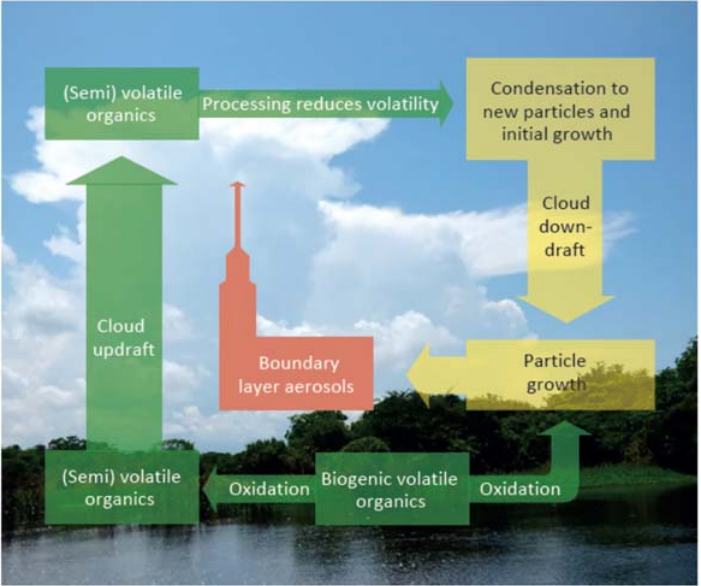
Conceptual model of the aerosol life cycle over the Amazon Basin (Andreae et al., 2018)

Partners
- Max Planck Institute for Chemistry, Mainz (MPIC)
- Goethe University Frankfurt
- Leibniz Institute for Tropospheric Research (TROPOS)
- Forschungszentrum Jülich (FZ Jülich)
- Karlsruhe Institute of Technology (KIT)
- University of Sao Paulo
- Instituto Nacional de Pesquisas Espaciais
Scientific instruments and payload configuration
List of scientific instruments for the mission:
-
HALO-CIMS
PAN/PAA, SO2, ClNO2, HCl, HNO3 | J. Crowley (MPI-C)
-
HALO-MGC
NMVOC | J. Williams (MPI-C)
-
TRIHOP
Total peroxides, H2O2, CO, HCHO, CH4 | H. Fischer (MPI-C)
-
NOAH/ATILLA
NO, NO2 | H. Fischer (MPI-C)
-
PTR-MS TOF
OVOC | J. Williams (MPI-C)
-
HORUS
OH / HO2 | H. Harder (MPI-C)
-
LIF-SO2
SO2 | H. Harder (MPI-C)
-
C-ToF-AMS
Aerosol composition (non-refractory) | J. Schneider (MPI-C)
-
CI-APiTOF MS
H2SO4, HOMs, MSA, amines, clusters | J. Curtius (Univ. Frankfurt)
-
CCN Rack
CCN, BC, aerosol impactor | M. Pöhlker (TROPOS)
-
FASD
Aerosol number and size distribution | M. Pöhlker (TROPOS)
-
HALO-SR
Actinic Flux | B. Bohn (FZ Jülich)
-
FAIRO
O3 | A. Zahn (KIT)
-
BAHAMAS
HALO Basic Data Acquisition System | Andreas Giez (DLR-FX)
HALO flights for this mission
Flights are listed by
Aircraft registration | Date | Take-off / Landing (UT) | Total flight time (h) | From / To | Mission #
- D-ADLR | 2022-11-16 | 10:45 – 13:48 | 3.23 | EDMO-EDMO | RF00
- D-ADLR | 2022-11-22 | 10:29 – 14:24 | 4.05 | EDMO-EDMO | RF01
- D-ADLR | 2022-11-25 | 07:57 – 12:45 | 4.95 | EDMO-EDMO | RF02
- D-ADLR | 2022-11-30 | 09:57 -16:07 | 6.43 | EDMO-GVAC | RF03
- D-ADLR | 2022-12-01 | 15:12 – 21:51 | 6.88 | GVAC-SBEG | RF04
- D-ADLR | 2022-12-04 | 12:32 – 20:24 | 8.23 | SBEG-SBEG | RF05
- D-ADLR | 2022-12-07 | 14:22 – 22:49 | 8.80 | SBEG-SBEG | RF06
- D-ADLR | 2022-12-09 | 15:25 – 00:03 | 8.90 | SBEG-SBEG | RF07
- D-ADLR | 2022-12-11 | 11:58 – 20:14 | 8.53 | SBEG-SBEG | RF08
- D-ADLR | 2022-12-14 | 11:19 – 19:06 | 8.13 | SBEG-SBEG | RF09
- D-ADLR | 2022-12-16 | 16:11 – 00:26 | 8.57 | SBEG-SBEG | RF10
- D-ADLR | 2022-12-19 | 14:34 – 21:54 | 7.73 | SBEG-SBEG | RF11
- D-ADLR | 2023-01-06 | 14:45 – 23:38 | 9.18 | SBEG-SBEG | RF12
- D-ADLR | 2023-01-08 | 20:23 – 05:27 | 9.25 | SBEG-SBEG | RF13
- D-ADLR | 2023-01-12 | 13:55 – 22:09 | 8.47 | SBEG-SBEG | RF14
- D-ADLR | 2023-01-14 | 11:58 – 20:48 | 9.03 | SBEG-SBEG | RF15
- D-ADLR | 2023-01-17 | 03:39 – 12:39 | 9.33 | SBEG-SBEG | RF16
- D-ADLR | 2023-01-18 | 12:18 – 21:43 | 9.77 | SBEG-SBEG | RF17
- D-ADLR | 2023-01-21 | 19:26 – 04:01 | 8.90 | SBEG-SBEG | RF18
- D-ADLR | 2023-01-23 | 08:47 – 18:51 | 10.35 | SBEG-SBEG | RF19
- D-ADLR | 2023-01-26 | 08:48 – 18:38 | 10.17 | SBEG-SBEG | RF20
- D-ADLR | 2023-01-28 | 09:34 – 15:35 | 6.30 | SBEG-GVAC | RF21
- D-ADLR | 2023-01-29 | 09:54 – 16:08 | 6.42 | GVAC-EDMO | RF22
More information
Mission overview paper
Isoprene nitrates drive new particle formation in Amazon’s upper troposphere
Citation:
Curtius, J., Heinritzi, M., Beck, L.J. et al. Isoprene nitrates drive new particle formation in Amazon’s upper troposphere. Nature 636, 124–130 (2024). https://doi.org/10.1038/s41586-024-08192-4
Press releases, media etc.
>> Initial Press release (5 December 2022)
Research in and high above the Amazon rainforest
joint press release of the Max Planck Institute for Chemistry, Goethe University Frankfurt, Universidade de São Paulo, and the Instituto Nacional de Pesquisas da Amazônia
Read more.. (English | Weiterlesen.. (Deutsch) – Max Planck