EUREC4A

Elucidating the Role of Cloud-Circulation Coupling
in Climate
Mission status: Completed
Skip to: >>Project description | >>Partners | >>Instrumentation | >>HALO configuration | >>Media & Press
Persons in Charge
Mission-PI
Bjorn Stevens, MPI-M, Hamburg
Mission coordinator
Lutz Hirsch, MPI-M, Hamburg
HALO Deployment Base
Time Period
Dec 2019 – Feb 2020
Project description
Mission overview paper
Citation:
Stevens, B. et al.: EUREC4A, Earth Syst. Sci. Data, 13, 4067–4119, https://doi.org/10.5194/essd-13-4067-2021, 2021.
A better quantification and physical understanding of how clouds respond to warming, and hence Earth’s Equilibrium Climate Sensitivity is recognized as one of the Grand Challenges of Climate Science. Research over the past decades has advanced to the point that testable hypotheses have been articulated, and these motivate “Elucidating the Role of Cloud-Circulation Coupling in Climate” (EUREC4A). The EUREC4A field campaign in January and February 2020 in the vicinity of Barbados will elucidate how the macrophysical properties of trade-cumuli depend on the dynamic and thermodynamic properties of the environment in which the clouds form. As two primary objectives, we will
- Quantify cloud macrophysical properties as a function of the large scale environment in the winter trades of the North Atlantic, and
- Provide a reference data set for modelling and remote sensing clouds and circulation in the trades. More specifically, EUREC4A aims to answer the following key questions of climate modelling and prediction:
- What controls the convective mass flux, mesoscale organization, and depth of shallow clouds?
- How does the cumulus cloud amount in the trade wind boundary layer vary with turbulence, convective mixing and large-scale circulations, and what impact does this variation have on the atmospheric radiation field?
EUREC4A has attracted a lot of international attention. In addition to HALO and ATR-42 two additional research aircraft and four research vessel will join the campaign as additional platforms. The ships will host numerous autonomous observing systems of the atmospheric boundary layer or the ocean. The measurement setup is displayed in Fig. 3.22. The large international attention is also recognized by The World Climate Research program (WCRP), which has endorsed EUREC4A as capstone experiments of the Grand Science Challenges on Cloud Circulation and Climate Sensitivity. In parallel EUREC4A has become the nucleus for other related scientific activities that intend to join the experiment and will enrich the data set: EUREC4A-OA/ATOMIC (European Ocean-Atmosphere component of EUREC4A / Atlantic Tradewind Ocean- Atmosphere Mesoscale Interaction Campaign by the US) will coordinate the four research vessels. They will observe ocean state and exchange fluxes and will serve as platforms for ground based remote sensing and in-situ profiling by radiosondes of the cloudy atmosphere. EUREC4A-ISO will explore the water isotope signature and help to disentangl the various processes affecting the water budget of cumulus clouds. EUREC4A-Wind will bring together investigators from different institutes to promote a better understanding of the coupling of winds, convection and clouds and their importance for weather and climate prediction in the trades. In particular, this initiative will explore and validate the potential of the ESA ADM-Aeolus mission. EUREC4A-Model will accompany the campaign with high-resolution numerical simulation with a grid spacing of 1 km or less using the ICON model and link the campaign with most recent cutting-edge initiative of cloud resolving global models (cf. Dyamond project, www.esiwace.eu/services/dyamond).

Figure 3.22: Schematic plan of envisioned platform deployment during EUREC4A east of Barbados during January and February 2020
Partners
- Max Planck Institute for Meteorology, Hamburg
- University Hamburg
- German Aerospace Center, Institute of Atmospheric Physics (DLR-IPA)
- Leipzig University
- Karlsruhe Institute of Technology (KIT)
- University of Cologne
- Ludwig-Maximilians-Universität München (LMU)
Scientific instruments and payload configuration
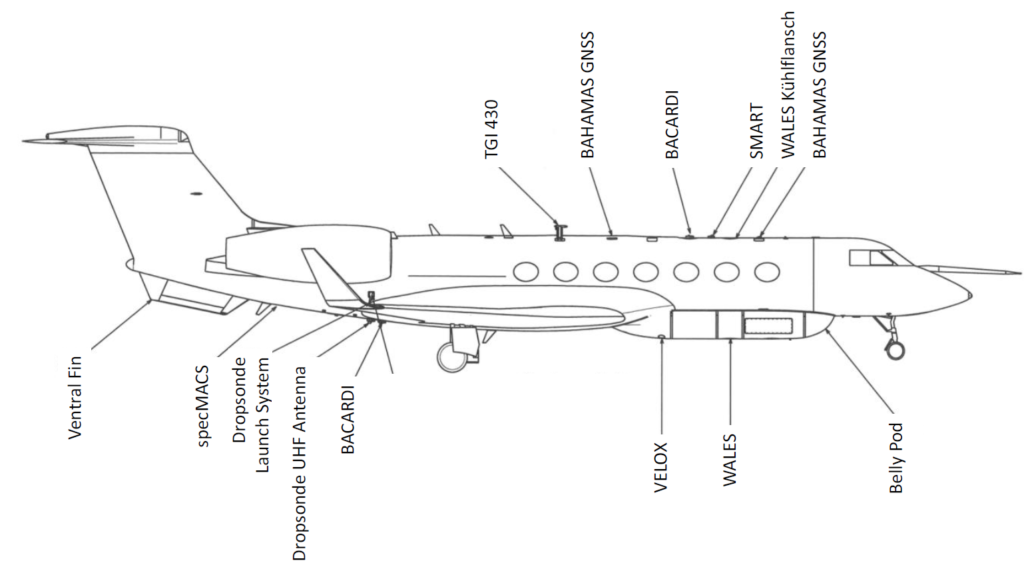
List of scientific instruments for the mission:
-
HAMP
Cloud Radar | L. Hirsch (MPI-M)
-
HAMP
Radiometer | F. Jansen (MPI-M)
-
WALES
LIDAR | M. Wirth (DLR-IPA)
-
SMART
Spectral Modular Airborne Radiation measurement sysTem | A. Ehrlich (U. Leipzig)
-
specMACS
spectrometer of the Munich Aerosol Cloud Scanner | T. Zimmer (LMU Munich), V. Pörtge (LMU Munich)
-
VELOX
Broadband camera system (infrared) | M. Schäfer (Leipzig Univ.)
-
Dropsondes
Meteorological dropsondes | A. Lübcke (U. Leipzig)
-
BAHAMAS
HALO Basic Data Acquisition System | Andreas Giez (DLR-FX)
-
BACCARDI
Broadband upward and downward irradiances | A. Giez (DLR-FX) & A. Ehrlich (Univ. Leipzig)
Cabin and exterior configuration of HALO for the mission
More information
Mission overview paper
Citation:
Stevens, B. et al.: EUREC4A, Earth Syst. Sci. Data, 13, 4067–4119, https://doi.org/10.5194/essd-13-4067-2021, 2021.
ESSD special issue
Press releases, media etc.
Initial press release
Clouds as a factor influencing the climate – EUREC4A field campaign aims to solve one of the great mysteries of climate science
Read more.. (in English) | Weiterlesen.. (auf Deutsch)
>> Find all HALO updates, Media releases, and meeting announcements.
overview about the media coverage of the campaign on misison webpage (click >>here.)