CoMet 2.0Arcticaims to learn more about the distribution and temporal variation of thetwo most important anthropogenically–influenced greenhouse gases, carbon dioxide(CO2)and methane(CH4)in the Arctic. Aircraft–basedinstruments using both remote sensing andin–situtechniques will carry outmeasurements of these tracegasesandtracersrelated totheir emissions. The results will help to better understand the global methane and carbon cycle. This missionmakes use ofthe German research aircraft HALO.
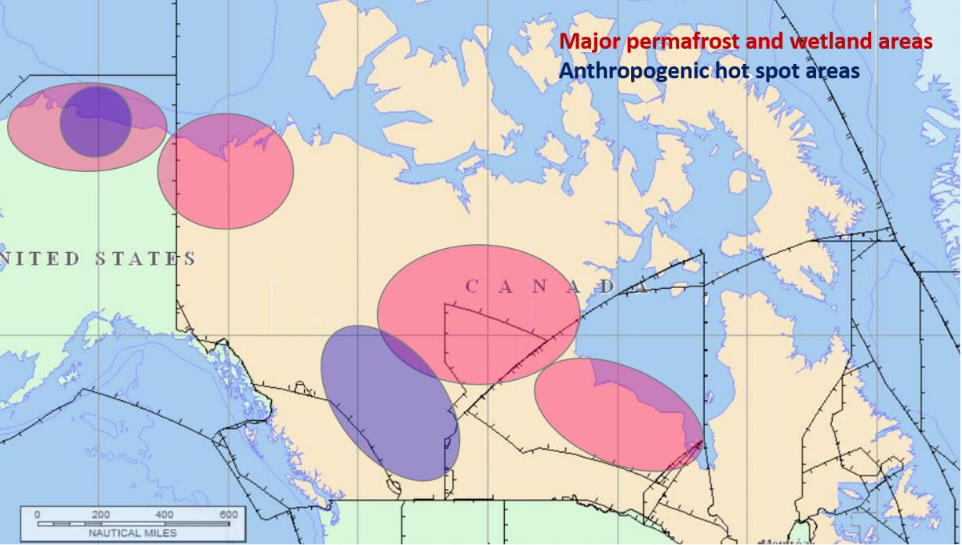
CoMet 2.0Arctic is the follow-up campaign from CoMet, which took place in 2018. This campaign took place in Europe and targeted compact emission-sources of CO2 and CH4 like coal mines, coal-burning power plants or landfills. With the expericenes gained from this campaign, we target now emission-sources with much weaker gradients, like boreal wetlands and permafrost araes, but also anthropogenic hot spotsin theAlaskan and Canadian Arctic.
The figure displays the target areas for the CoMet Arctic campaign. These comprise boreal wetlands and permafrost araes, but also anthropogenic sources.
For the CoMet2.0mission,HALO will be equipped with a suite of sophisticated instrumentsmeasuring the carbon dioxide and methane columnsbetween the aircraft and theground usingremote sensing,as well as in–situ instruments that collect air samples at flight level. Furthermore,instruments to provide detailed informationaboutthe standard meteorological parameters(pressure, wind, humidity) will also be on board. In order to link those in–flight data to profiles, thelaunchofsmall meteorological sondes is foreseen.Thepayload is exclusively dedicatedtoatmosphericmeasurement.
The payload of the COMET mission will be extended with the integration of the new MAMAP2D instrument. This 2-dimensional imaging spectrometer system measures CO2 and CH4. It is the successor instrument of MAMAP which was flown on the Cessna 207 during COMET. Including these measurements on the same platform with the other remote sensing (CHARM-F, mini-DOAS) and in situ (JIG, JAS) instruments facilitates further synergies for data analysis. Furthermore, the core payload will be complemented by a quantum cascade laser spectrometer to measure ethane (C2H6), a tracer for emissions from oil and gas emissions.
The following table givesan overview on the instrumentsonboard the aircraftduring CoMetand their measurement parameters:
CHARM-F
Integrated path differential absorption lidat (IPDA) | Andreas Fix (DLR-PA)
MAMAP
Imaging NIR Spectrometer | Heinrich Bovensmann (Uni Bremen)
miniDOAS
UV/VIS/NIR Spectrometer | Klaus Pfeilsticker (Univ. Heidelberg)
JIG
Cavity-Ringdown Spectroscopy (CRDS) | Christoph Gerbig (MPI-BGC)
JAS
Air sampler | Christoph Gerbig (MPI-BGC)
MIRACLE
Laser Spectrometer | Anke Roiger (DLR-PA)
specMACS
Hyperspectral Imaging | Florian Ewald (DLR-PA)
BAHAMAS
HALO Basic aircraft measurement system | Andreas Giez (DLR-FX)
Dropsondes
Meteorological dropsondes | Stefan Kaufmann (DLR-PA)
This website uses cookies to improve your experience. We'll assume you're ok with this, but you can opt-out if you wish. Cookie settingsACCEPT
Privacy & Cookies Policy
Privacy Overview
This website uses cookies to improve your experience while you navigate through the website. Out of these cookies, the cookies that are categorized as necessary are stored on your browser as they are essential for the working of basic functionalities of the website. We also use third-party cookies that help us analyze and understand how you use this website. These cookies will be stored in your browser only with your consent. You also have the option to opt-out of these cookies. But opting out of some of these cookies may have an effect on your browsing experience.
Necessary cookies are absolutely essential for the website to function properly. This category only includes cookies that ensures basic functionalities and security features of the website. These cookies do not store any personal information.
Any cookies that may not be particularly necessary for the website to function and is used specifically to collect user personal data via analytics, ads, other embedded contents are termed as non-necessary cookies. It is mandatory to procure user consent prior to running these cookies on your website.