
Oxidation Mechanism Observation
Mission status: Completed
HALO on the airport of Gan (Maldives)
during the OMO-Asia campaign

Mission status: Completed
HALO Project Management: Martina Hierle
Postal address:
DLR Oberpfaffenhofen
Flugexperimente (FX)
Münchener Str. 20
82234 Weßling
Germany
HALO was operated from different bases during this mission:
The OMO mission with HALO consisted of two field campaigns: OMO-EU and OMO-Asia.
OMO-EU campaign phases:
OMO-Asia campaign phases:
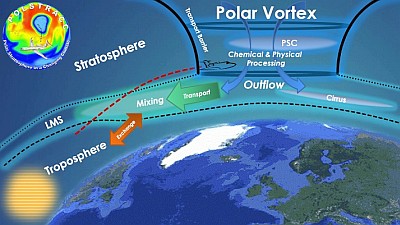
The OMO aircraft measurement campaign addressed the „self-cleaning capacity“ of the atmosphere. It focused on oxidation processes and air pollution chemistry downwind of South Asia during the summer monsoon. The self-cleaning mechanism converts natural and human-made pollutants into more soluble products that can be removed by rain. This is critical for air quality and climate change, both regionally and worldwide considering rapidly growing pollution emissions, especially in Asia.
HALO on the airport of Gan (Maldives)
during the OMO-Asia campaign
The measurements took place in July and August 2015 in the upper troposphere at 10-15 km altitude. The goal was to study the influence of convective clouds and rainfall on atmospheric composition during the monsoon. While soluble gases and aerosol particles can rain out, the removal efficiency is poorly known. Monsoon clouds can have a strong and large-scale impact on atmospheric chemistry through the vertical redistribution of sunlight, pollutants and humidity. The chemical, transport and deposition processes are investigated to advance computer models and improve air quality and climate change calculations.
The German institutions of the consortium belong to the Max Planck Society, the Helmholtz Association and universities that have a track record in airborne atmospheric research, for example in the Indian Ocean Experiment, conducted in the dry season, to which the OMO measurements can be contrasted. The consortium has recently developed a comprehensive set of instrumentation for the HALO aircraft.
The flight patterns included tracks across the Arabian Sea, the Arabian Peninsula, the Indian Ocean and the Mediterranean Sea to study zonal and meridional concentration gradients and large-scale impacts of the monsoon. Vertical (stack) flights were performed in regions of particular interest, so that a range of atmospheric conditions could be analyzed and the extent of pollution layers investigated. The measurements document long-distance pollution transports and their influence on regional-to-global atmospheric composition and climate.
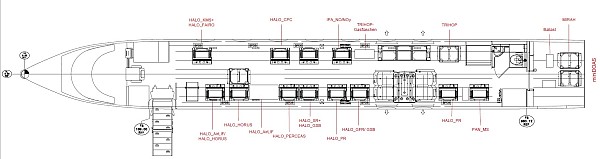
OH / HO2 / NO2 | H. Harder (MPI-C, Mainz)
OH / HO2 / NO2 | F. Holland (FZ Jülich)
RO2 | L. Hernández (Univ. Bremen)
Actinic flux | B. Bohn (FZ Jülich), M. Wendisch (Univ. Leipzig)
Fast Ozone measurement | A. Zahn (KIT)
OVOC | A. Zahn (KIT)
NMVOC | J. Williams (MPI-C, Mainz)
Total Peroxides | H. Fischer (MPI-C, Mainz)
NOy | H. Ziereis (DLR-PA)
SO2, HNO3 | H. Schlager (DLR-PA)
Condensation particle counter | H. Schlager (DLR-PA)
VOC & isentopes | R. Koppmann (Univ. Wuppertal)
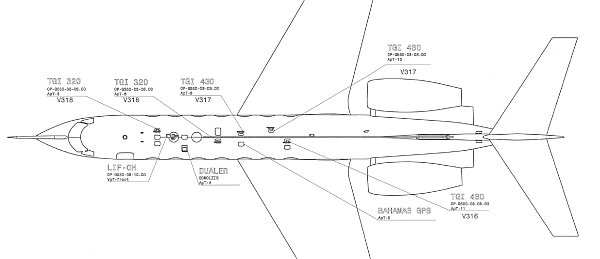
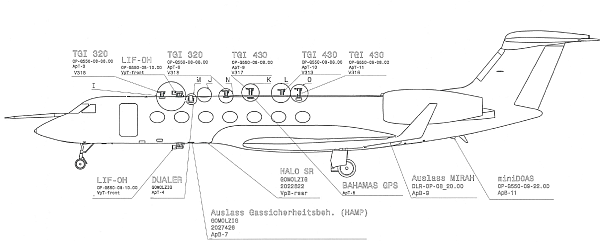
Differential Optical Absorption Spectroscopy | K. Pfeilsticker (Univ. Heidelberg)
HALO Basic Data Acquisition System | A. Giez (DLR-FX)
Flights are listed by
Aircraft registration | Date | Take-off / Landing (UT) | Total flight time (h) | From / To | Mission #
Flights are listed by
Aircraft registration | Date | Take-off / Landing (UT) | Total flight time (h) | From / To | Mission #
Press release German Embassy Nicosia (August 11, 2015):
German research aircraft in Cyprus
Press release Max-Planck-Institut für Chemie (May 17, 2015)
Flying 100,000 kilometers through the monsoon
Report in „in-cyprus“ (August 14, 2015):
Monsoon research in Paphos
Report on DLR-FX homepage (August 6, 2015):
HALO auf Kampagne „OMO-Asien“
Press release DLR (July 17, 2015):
Forschungsflugzeug HALO: Auf der Langstrecke für Messungen im asiatischen Sommermonsun