
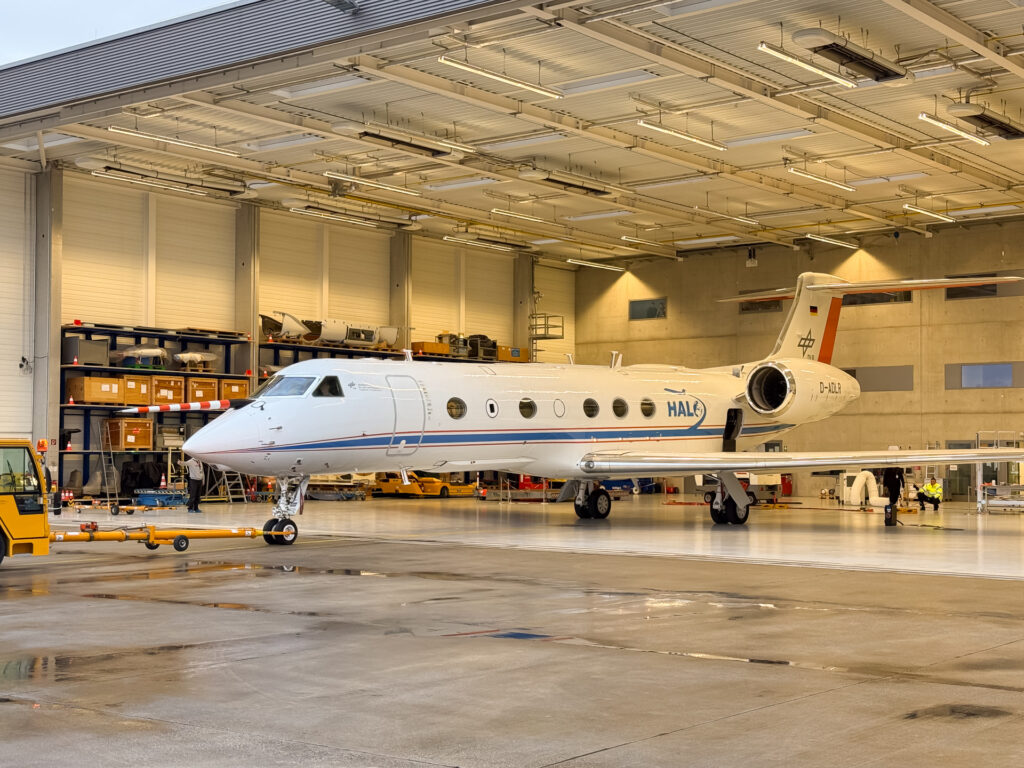
The NAWDIC mission has officially begun with the transfer flight of the research aircraft HALO from Oberpfaffenhofen to Shannon, Ireland, on 13 January 2026. This flight also marked the first scientific measurement flight of the campaign. From its base in Shannon, HALO will conduct extended research flights over the North Atlantic, targeting dynamically active weather systems during the winter season.
NAWDIC (“North Atlantic Waveguide, Dry Intrusion, and Downstream Impact Campaign”) is an international field campaign dedicated to the investigation of winter weather processes over the North Atlantic. The focus lies on the interaction between upper-level jet streams, dry intrusions and their downstream impacts on the development of storms, heavy precipitation events and cold-air outbreaks over Europe. The observations collected during NAWDIC are intended to support the improvement of numerical weather prediction models and medium-range weather forecasts.
The overall project is coordinated by the Karlsruhe Institute of Technology (KIT) and combines HALO flights with additional aircraft-based, ground-based and satellite observations. The NAWDIC-HALO project is jointly led by KIT and the DLR Institute of Atmospheric Physics and involves a broad international consortium of research institutions.
For the NAWDIC campaign, HALO carries a comprehensive scientific payload combining active remote sensing and in-situ measurements to characterise atmospheric structure and composition from the lower stratosphere down to the planetary boundary layer. Core remote sensing instruments developed and operated by the DLR Institute of Atmospheric Physics are the water vapour and ozone lidar WALES and the wind lidar HEDWIG, providing vertically resolved profiles of humidity, ozone and wind beneath the aircraft.
These systems are complemented by a suite of in-situ instruments contributed by partner institutions: the UMAQS trace gas instrument operated by Johannes Gutenberg University Mainz measures carbon monoxide (CO), ethane (C₂H₆), methane (CH₄) and nitrous oxide (N₂O); the FISH hygrometer from Forschungszentrum Jülich provides high-precision water vapour measurements; and the FAIRO instrument from KIT measures ozone in situ. In addition, KITsonde dropsondes developed and operated by KIT are released from HALO to obtain high-resolution vertical profiles of temperature, humidity and wind in dynamically relevant regions of the atmosphere.
From an operational perspective, the campaign places high demands on planning and execution. Measurement flights over the North Atlantic are characterised by dynamically changing transatlantic traffic structures (NAT tracks), high traffic density and the absence of continuous radar coverage. The DLR facility Flight Experiments (FX) is therefore closely involved in coordination with the responsible air navigation service providers well in advance. During flight operations, the flight crews ensure safe and compliant integration into international air traffic, primarily using data-based communication via CPDLC.
The measurement campaign is planned for a duration of six weeks, during which at least 120 flight hours with HALO are scheduled. Operating from Shannon, the flights will reach remote regions of the North Atlantic and are conducted in close coordination between flight crew, scientific teams and air traffic control. In total, more than 100 researchers from Europe and North America are involved in NAWDIC.
Further information:
- NAWDIC mission information here on the HALO homepage: https://halo-research.de/nawdic
- NAWDIC homepage: NAWDIC – Home
- Information on NAWDIC-HALO: NAWDIC – Projects – NAWDIC-HALO
- KIT’s press release: Wetterprozesse im Winter besser vorhersagen | KIT
- DLR’s press release: For better winter weather forecasts – HALO measurement flights over the North Atlantic
- FZJ’s press release: Improving forecasts of winter weather in Europe


